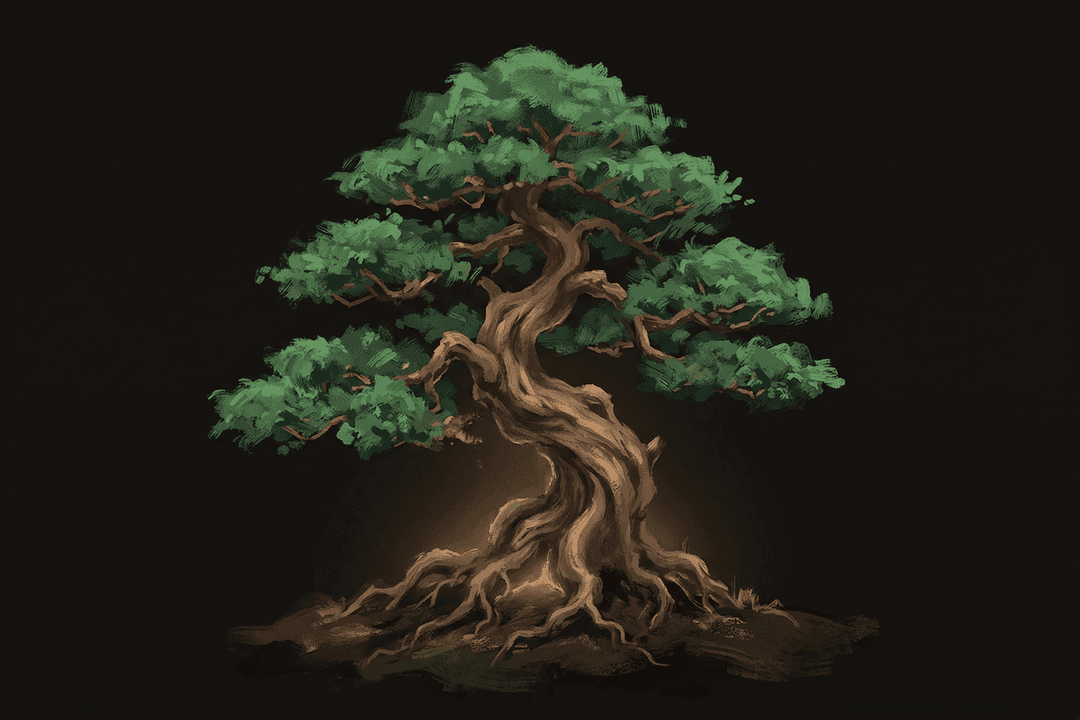
One of the hardest concepts for the human brain to grasp is exponential growth. It doesn't arrive gradually — it arrives like a tsunami. By the time you see it, it's already here.
Let's step back a moment and look at how we got here. Then we'll see why Seed was inevitable.
So, A.I. happened. Obviously. But now we're seeing all the second-order effects of its introduction:
- Integrated development environments gave way to apps like Codex — where you couldn't even see the code anymore.
- Developers started shipping code they'd never personally read.
- The A.I. went from writing the code, to checking the code, to planning the code, to testing the code.
Ok, ok. We've got a trend here. The A.I. is certainly going to take over nearly all aspects of software.
Except one.
Deciding what to build.
We still need humans to decide what to build. To guide and shape the software into its final form.
Which leads to the inevitable arrival of Seed.
Self-modifying, evolving code that needs only one thing from a human: direction.
The paradigm shift here is not merely from static software to dynamic software. It's a shift from growth to exponential growth.
This is the end of software “versions” — and the start of organic code, constantly evolving as necessary to become what is required.
This is the end of the IDE and the beginning of the Self-Contained Evolutionary Entity.
This is the end of the Dev and the beginning of the Shaper.
Today, Seed is the worst it's ever going to be.
Come back tomorrow to see what it becomes.
// what-seed-is
What Seed Actually Is
Seed is not a code generator. It's not an AI assistant. It's not an IDE, a framework, or a copilot.
Seed is a program that evolves itself.
You plant an idea — a description of what you want, in plain language. Seed writes the first generation of code. That first generation is rough. Imperfect. A sprout. Then Seed evaluates what it wrote, learns from the result, and writes the next generation. And the next. And the next.
Every generation builds on everything before it. Mistakes aren't repeated — they're remembered. Patterns that work are reinforced. The code doesn't just change — it improves, compounding intelligence over time, the same way biological evolution compounds adaptation over generations.
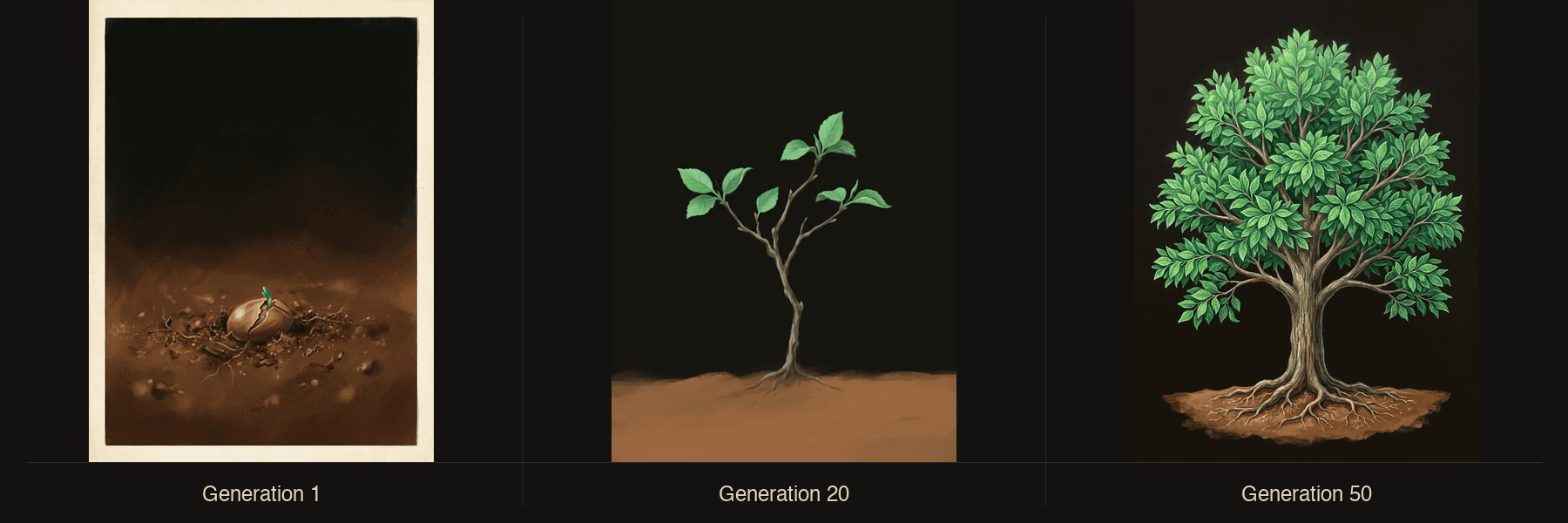
Gen 1 → Gen 20 → Gen 50
By Generation 5, structure is emerging. By Generation 20, features work. By Generation 50, you have software that you couldn't have designed by hand — because no human designer would have explored the paths that evolution discovered.
You don't write this software. You don't build it. You don't even fully design it. You shape it. You give it direction, observe how it grows, redirect when needed, and let it find solutions you never would have considered.
This is not a better way to develop software.
This is the end of software development as we've known it, and the beginning of something that doesn't have a name yet.
We call it growing.
// inevitability
Why This Was Inevitable
Zoom out far enough and you can see this coming from a long way off.
The complexity ceiling. Software systems are getting more complex faster than our ability to manage them. The average codebase today is orders of magnitude larger than what a single person can hold in their head. We've compensated with teams, processes, tools, and abstraction layers — but each compensation adds its own complexity. We're managing complexity with more complexity. That's a losing game. The only way through is to stop managing the complexity yourself and let something else handle it.
The talent bottleneck. There are roughly 30 million software developers in the world. There are 8 billion people with ideas. The gap between “people who want software” and “people who can make software” has never been wider. Every attempt to close this gap — no-code tools, AI assistants, drag-and-drop builders — has helped at the margins. But none of them removed the fundamental requirement that someone, somewhere, needs to understand how software works under the hood. Seed does.
The convergence of AI capabilities. Large language models can now generate functional code from natural language descriptions. That alone is impressive but not revolutionary. What's revolutionary is combining generation with evaluation and iteration — the same loop that drives biological evolution. Each capability existed independently for years. Seed is what happens when you wire them together into a single, self-improving system.
The economic pressure. Software is eating the world, but building it is still expensive, slow, and fragile. Businesses wait months for features. Solo creators abandon ideas because the technical barrier is too high. Open source projects burn out their maintainers. The economic incentive to find a fundamentally cheaper, faster, more accessible way to create software has never been stronger. Seed isn't just technically possible — it's economically inevitable.
The era of manually written software is approaching its end.
Not because it failed — because something better became possible.
// consequences
What Changes
If software can grow instead of being built, the consequences ripple outward in every direction.
The Creator Changes
For sixty years, creating software required a specific skill: writing code. That skill took years to learn, constant practice to maintain, and a particular kind of thinking that not everyone possesses. The result was a priesthood — a class of specialists who served as intermediaries between ideas and their execution.
Seed dissolves that priesthood. The skill that matters now is not syntax — it's intent. Can you describe what you want? Can you observe what's growing and give it direction? Can you recognize when something is heading the right way and when it needs a course correction? These are human skills. Universal skills. The skills of a gardener, not an engineer.
We call this new role a Shaper — someone who guides the evolution of software rather than constructing it by hand.
It's a role that didn't exist before because it couldn't exist before. The tools weren't ready. Now they are.
The Software Changes
Software built by hand is static by nature. It does what it was designed to do, in the way it was designed to do it, until a human comes back and changes it. Updates are expensive. Maintenance is a burden. The code rots as the world around it changes.
Software that grows is different. It can keep evolving. New generation, new capabilities. The environment changes, and the software adapts. Not as a patch or an update — as genuine evolution, the same way species adapt to changing conditions over geological time, except Seed operates on a timescale of hours and days instead of millennia.
Software stops being a finished artifact and starts being a living process.
You don't ship it and walk away. It continues to grow, to improve, to respond. The relationship between creator and creation becomes ongoing — not maintenance, but cultivation.
The Economics Change
Building software today is expensive because human expertise is expensive. A competent developer costs $100,000–200,000 per year. A team of them costs millions. The result is that most software that should exist doesn't exist — because nobody can afford to build it.
When software can be grown by anyone with an idea and patience, the cost of creation approaches zero. Not the cost of compute — the cost of human labor. Seed doesn't eliminate the need for human judgment, but it eliminates the need for human construction. The most expensive part of the process — translating intent into working code — becomes automated.
Ideas that were too expensive to build become free to grow.
Personal software — tools built for an audience of one — becomes practical. The long tail of software needs that no market could justify serving becomes accessible.
The Culture Changes
Today, “learning to code” is positioned as an essential skill — the literacy of the 21st century. There's truth in that framing, but it's also a reflection of the current paradigm. We tell people to learn to code because code is currently the only way to make software.
When that's no longer true, the essential skill shifts. The new literacy isn't writing code — it's directing growth. Understanding what you want. Evaluating whether what's growing matches your intent. Knowing when to intervene and when to let it evolve. These are creative skills, not technical ones. They're closer to writing, directing, or design than to engineering.
This doesn't make programming knowledge worthless. Understanding how software works under the hood will always be valuable — the way understanding physics is valuable even if you're not an engineer. But it stops being a prerequisite.
The door opens to everyone.
// the future
Why This Is an Awesome Future
It would be easy to frame this as a threat. “The end of software development” sounds like a loss — like something is being taken away. But look at what's being gained.
Everyone gets to create. The 8 billion people who have ideas but can't code? They can grow software now. The teenager with an idea for an app. The small business owner who needs a custom tool. The artist who wants interactive installations. The scientist who needs bespoke analysis software. The novelist who wants a writing companion tailored to their process. All of them gain the ability to bring their ideas to life without learning a programming language or hiring a team.
Software becomes personal. When the cost of creation is low enough, you don't need to settle for one-size-fits-all. You can grow software that fits your exact needs — your workflow, your preferences, your quirks. Not configured, not customized — grown for you, shaped by you, evolved to fit like a glove. Personal software has been a dream since the personal computer. Seed makes it practical.
Creativity is unleashed. When the bottleneck between imagination and execution is removed, what happens? We don't fully know yet. But every time a creative barrier has been lowered in the past — the printing press, the camera, the synthesizer, the web — the result has been an explosion of expression that nobody predicted. The barrier to software creation has been one of the highest barriers in human history. Removing it will produce things we can't imagine yet.
The gap between “what if” and “let's try it” shrinks to nearly zero.
The pace of innovation accelerates. Software is the substrate of modern innovation. Every new business, every new service, every new tool — it's all software. When creating software goes from months to days, from teams to individuals, from expensive to free — the entire innovation cycle speeds up. Problems get solved faster. Ideas get tested faster.
Developers aren't replaced — they're elevated. The best developers have always been frustrated that they spend most of their time on mechanical work — boilerplate, plumbing, glue code — instead of solving interesting problems. Seed handles the mechanical work. What's left is the genuinely creative part: architecture, design, system thinking, the hard problems that actually require human insight. Developers who embrace the shift become Shapers with superpowers — they bring deep technical understanding to a tool that amplifies it by orders of magnitude.
Software becomes more resilient. Evolved software, like evolved biological systems, tends to be more robust than designed software. Evolution explores a wider solution space than any human designer. It discovers redundancies, fault tolerances, and optimizations that no one would have thought to implement. Over time, grown software may simply be better software — not because the AI is smarter than humans, but because evolution is a more powerful search algorithm than design.
// path-forward
The Path Forward
We're at the very beginning of this. Seed today is a sprout — early, imperfect, finding its shape. The first generation, if you will.
But the trajectory is clear. Every improvement in language models makes Seed more capable. Every generation of hardware makes it faster. Every Shaper who grows something and shares what they learned makes the community smarter. The compounding has already started.
What we're building isn't just a tool.
It's the first step into a world where the question isn't “can you code?” but “what do you want to grow?”
The era of software development — of humans translating intent into syntax, line by painstaking line — lasted sixty years. It accomplished miracles. It changed the world. And it was always heading here.
To software that grows.
Christopher
// begin
Plant your first Seed at selfmodifyingcode.ai